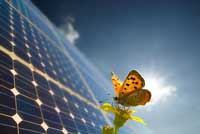
India is Rapidly Developing Solar Energy
via Photovoltaic & Thermal Systems
By Brook & Gaurav Bhagat
November 17, 2003
Jodhpur, Rajasthan, India
A Vast Vineyard of Solar Electricity
Kramer Junction in the sunny state of California
Editor's Note: Solar energy in its raw form may be pollution-free, but
manufacturing the devices that get the energy out of light and heat
requires metal and other material, requiring mines and smelters, therein
causing pollution. Maybe the most exciting thing about solar energy
today is not only that the costs continue to drop and efficiencies continue
to rise, but that clean solar energy is arriving at last. New technologies
allow new methods of manufacturing which pollute much less, and often
run on solar energy.
Solar heating and solar electric systems can now generate thermal and
electric energy over their service life up to 100 times the energy input
during their manufacture. This ratio; the energy it will produce in
its lifetime, compared to the amount of energy input to manufacture
and maintain an energy system, has doubled in the last 20 years for
most solar technologies. The ratio of energy out vs. energy in for solar
systems has become so favorable that the economic and ecological viability
of solar power is now beyond question.
One reason solar energy still cannot compete financially vs. conventional
energy is because the value of future energy output from a photovoltaic
system is discounted when calculating, for example, an internal rate
of return. These economic models that put a time-value on money, making
long-term receipts not worth as much as near-term receipts cannot necessarily
be applied to energy. Traditional models of economic analysis for an
energy system lasting 50 years treat the free energy in years 11 through
50 as nearly worthless. The underlying assumption when discounting returns
beyond 10 years is that BTUs are as fungible as currencies; something
that is arguable but not certain. If a society as a whole desires energy
independence, a solar energy system's return on investment in year 50
is no less valuable than the return on investment in year one.
As forests and fossil fuels diminish, look to solar energyas one of
the most promising sources of alternative energy.
"At the present rate of energy consumption, the reserve of fossil
fuels of the entire world can be exhausted in 50 to 100 years,"
said Dr. M. N. Nahar, principal scientist of the Division of Agriculture
and Energy at the Central Arid Zone Research Institute (CAZRI). "There
is an urgent need to harness solar energy and other alternative energy
sources."
Unlike natural gas, coal, or nuclear power, solar power requires no
fuel, works without polluting the air or leaving behind dangerous radioactive
waste, and is extremely plentiful. Researchers estimate that the sun
produces enough energy in a single second to meet the needs of all humanity
for 2000 years. "The surface of the Earth receives an amount of
solar energy equivalent to roughly 10,000 times the world energy demand,"
wrote Erik Lysen in the January 2003 issue of Renewable Energy World
magazine.
Figuring out how to harness it has already been accomplished, to some
extent. Solar technology is currently divided into two categories, thermal
and photovoltaic. Thermal solar power uses the heat of the sun, and
photovoltaics, or PV, is the technology that converts its light directly
into electricity.
A photovoltaic panel consists of several connected 0.6-V dc PV cells,
which are made out of a semiconducting material, generally mono- or
multi-crystalline silicon. The thin layer of silicon is sandwiched between
two metallic electrodes, and the cells are usually encapsulated behind
glass to make them weatherproof.
Multiple PV panels can be then connected to form an array, capable of
providing sufficient power for everything from common electrical applications
like single-household electricity to Olympic swimming pools, apartment
or industrial buildings. The average lifetime of a PV system is about
20 years, and it can be used in combination with conventional power
or alone. The only problem is that, although in some cases it is becoming
competitive, solar power is generally still slightly more expensive
than tapping into conventional electricity. The process of constructing
PV cells is somewhat complicated and delicate, and there is also a considerable
loss of materials. Multi-crystalline silicon wafers are obtained from
ingots grown by casting liquid silicon in a large container followed
by controlled cooling, a technique less complicated than the pulling
of single-crystalline rods. Then, in sawing the thin layer of crystalline
silicon, about 20% of the material is lost as "sawdust".
Efficiency is also not high, although it has been progressively increasing.
A solar cell made of multi-crystalline silicon, which accounts for most
of the PV panels currently in use and production, converts sunlight
to electricity at about 13.5% efficiency. Mono-crystalline silicon,
which is more difficult to produce, can achieve about 15%; in both cases,
clouds and night time also rob the cell of a further 65%.
One way to reduce PV costs is to use materials other than silicon as
semiconductors, like amorphous silicon and cadmium telluride (CdTe).
Although government grants are keeping the fire going, the technology
is moving slowly, and thin-film PV panels are hard to mass-produce cost-effectively
because of the difficulty of coating large areas of glass. "It
is my opinion that crystalline- silicon technologies will dominate for
at least the next 10 years," said Jeffrey Mazer of the U.S. Department
of Energy (DOE) Office of Solar Energy Technologies in Washington.
There is one instance, however, in which PV energy is already cheaper
than using fossil fuels. If a location is not currently connected to
the "grid," that is, if no power lines are there, it is less
expensive to install PV panels than to either extend the grid or set
up small-scale electricity production with a diesel or other generator.
the average cost of extending those power lines ranges from $20,000
to $80,000 per mile, a cost the consumer usually has to bear. At this
price, eliminating a power line extension of even one mile could well
pay for the PV system for someone who can easily afford it-- or make
electricity possible for someone who can't.
Approximately two billion people, or about 1/3 of the global population,
residing primarily in developing countries, are not connected to the
grid, and may never be; in this area particularly solar is the energy
source of the future, as these places develop. "For electricity
production in rural areas in developing countries, solar energy is the
cheaper alternative," said Nahar. Indeed, the demand for PV is
growing faster outside than inside the U.S.
Photovoltaics first came into use in 1958 when NASA needed a feasible
power source for its spacecrafts and satellites, and has been used for
this purpose ever since.
Other current uses of PV solar panels include powering watches and pocket
calculators, powering the lamps of some remote lighthouses, and solar-energy
systems in homes and buildings in Western countries. In the United States
and Europe alone, about 15,000 vacation homes are equipped with PV systems;
some environmentally-conscious consumers are willing to pay more for
clean energy.
The popularity of building-integrated photovoltaics (BIPV's), in particular,
has grown considerably in recent years. BIPV's are PV devices designed
directly into building materials like roofs, shingles, and siding, which
offer electricity and aesthetics, eliminating the need for mounted solar
panels.
The cost of a BIPV system is also partially offset by replacing the
costs of conventional construction materials. The system helps insulate
and protect roofing structures, and BIPV life expectancies range in
excess of 30 years, 33% higher than normal solar panels. There are currently
more than 3,000 BIPV systems installed in Germany, and Japan has a program
that plans to build 70,000 new BIPV buildings.
In terms of overall installed PV capacity, India comes fourth after
Japan, the US and Germany (Indian Ministry of Non-conventional Energy
Sources 2002). "India is the only country which has a separate
ministry for alternative energy," Nahar said. "Government
support and subsidies have been a major influence in our progress."
India is also in a good position because of the intense heat. "Arid
regions receive plentiful solar radiation," he said. In computed
global solar radiation of arid stations in the Indian states of Rajasthan,
Gujarat and Haryana, it was found that Jaisalmer, Rajasthan, receives
the maximum radiation at 6.27 kWh/m2 per day; the average daily duration
of bright sunshine in Jodhpur, Rajasthan is 8.9 hours.
"Thermal solar energy can be used for water heating, cooking, drying,
water distillation, refrigeration, and space heating and cooling,"
continued Nahar. One of the most crucial of these uses is cooking, as
half the total energy consumed in developing countries is used in the
domestic cooking sector; there are currently over 500,000 solar cookers
in use in India, according to Nahar, including the world's largest solar
cooking venue in Tirupati, which provides food for over 15,000 people
each day.
Solar dryers, for dehydrating vegetables, and solar water heaters are
also becoming popular. "Conventional water heaters require copper
piping," Nahar said. "We have developed models using gerberized
steel." These water heaters are currently used in hotels and hospitals,
providing up to 100,000 litres of water per day; the cost of these is
also decreasing steadily (Figure 3).
Another important area of development is that of solar stills, by which
the acute draught and shortage of potable water, currently the cause
of many physical disorders, can be alleviated.
In the latest models of solar stills, presuming the potable limit to
be 1500 PPM TDS, as much as 50 litres per day of potable water can be
made available from raw water with salinity of 5000 PPM TDS by installing
a solar still of capacity 35 litre/day. If the per person requirement
for drinking and cooking is 5 litres/day, this is enough for a family
of 10.
Income can also be derived from solar stills. Considering the cost of
the still, interest and maintenance, solar distilled water costs Rs.
0.98/litre, and the current market rate of distilled water is Rs. 3/litre.
A solar still for the production of rose water has also been developed,
which can be quite profitable. A unit with glass area 0.6 m2 costs only
Rs. 900. Although irrigation facilities are required, the unit produces
approximately 36 litres of rose water per month. The current market
rate for rose water is Rs. 50/litre, which means that in the first month
the unit has paid for itself-- twice.
Other important areas of alternative energy development are those of
wind power and biogas. Biogas plants have become increasingly prevalent--The
present capacity of biomass-based power generation totals 358 MW and
42.8 MW biomass gasifier power has been installed and regarding wind
power India keeps fifth place after Germany, the US, Denmark and the
UK with a total wind power generation of 1507 MW (MNES 2002).
"The future of solar energy is bright," Nahar said. "In
the last 20 years, the cost of conventional power has been going up,
and the cost of solar energy has been coming down."
Brook and Gaurav Bhagat are writers and independent filmmakers based
in Jodhpur, Rajasthan, India.
http://www.ecoworld.com/Home/Articles2.cfm?TID=339