













|
How Solar Inverters WorkTo explain how solar inverters work, we must start from the basics. The sun shines down onto photovoltaic
(PV) cells. These cells are made of semiconductor layers of crystalline
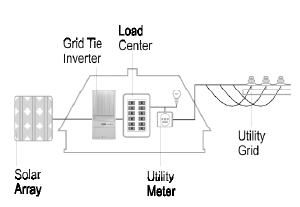
silicon or gallium arsenide, and they are arranged into panels. The semiconductor layers are a combination of both positive and negative layers, and they are connected through a junction. Basically, as the sun shines down, the semiconductor material absorbs the light, transferring the light’s energy to the PV cell. This energy knocks electrons loose, and they move from one layer to the other, thereby producing an electric current. This is a direct current (DC). The energy created is then generally either stored in a battery bank for later use or sent directly to an inverter, depending on the set up and type of system. For regular consumer use, and alternating current (AC) is needed – 120 volt AC powered home appliances require AC electricity. This is where an inverter comes in. The inverter takes the direct current and, in simplified terms, runs it through a transformer. It is almost as though the inverter is tricking the transformer into thinking it is getting AC by forcing the DC to act in a way similar to AC – the inverter runs the DC through two or more transistors that are rapidly turned on and off and feeding two different sides of the transformer. Sine Waves The DC electricity produced in the PV cells does not have a wave form, but is rather a direct line (hence its name, direct current.) Basically, to become AC, it must become a sine wave (on an x-y graph, the sine wave rises from 0 to a positive point, then back down through zero to a negative point and back up to 0. This known as one cycle or a hertz – a regular sine wave has 60 hertz per second [the sine wave continues to repeat itself 60 cycles per second.]) The alternating current used by a city electric grid is a true sine wave. It runs smoothly up and down in an arced, wave-like motion. Of course, an inverter that produces a pure sine wave often costs more than other inverters – only higher quality solar inverters produce true sine waves. A modified sine wave, on the other hand, rises up to the positive point and down to the negative point in steps – it looks like a stepped square wave. While many appliances will run on this type of sine wave, they may not run as well (e.g. while computers and TV’s will run, certain bread makers, microwaves, washer and dryers, etc. may have problems with the modified sine wave.) Also, items with motors will end up using more power when using a modified sine wave versus a true sine wave. Note that the effectiveness of modified sine wave inverters (also known as quasi-sine wave inverters and modified square wave inverters) can vary between different inverters and can vary depending on the load. The least effective modified sine wave inverters are only useful for very basic appliances like toasters and appliances that use only a heating element. In the case of inverters, the old adage is true: you get what you pay for.


 |
     |

   Copyright © 1998 - 2010 All Rights Reserved
|