













|
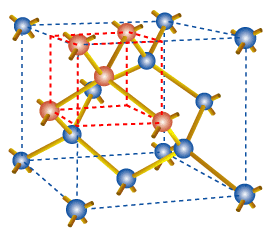
Crystalline SiliconSilicon is the second most abundant element in the Earth’s crust besides oxygen. Silicon used in solar cell construction is refined to an almost 100% purity. Single-crystalline silicon is more efficient at electricity generation from solar panels but is more expensive than poly-crystalline manufacturing. Crystalline cells are uniformly constructed from slices of a large single crystal ingot. The orderly arrangement of atoms results in sunlight conversion efficiency. Poly-crystalline silicon is composed of many crystals, or grains. Atomic order is disrupted at grain interfaces, making poly-crystalline silicon less efficient at converting sunlight power into electricity. The most widely used technique for making single-crystalline silicon lowers a seed of single-crystalline silicon into a vat of molten silicon. As the seed is raised from the vat, atoms of the molten silicon solidify around the seed, creating a long, cylindrical silicon ingot with similarly structured crystals. Semi-crystalline PV undergoes a casting process, in which molten silicon is poured into a mold and solidified into an ingot. The crystalline ingots are then sliced into thin, fragile wafers that work as PV cells encapsulated between two thick sheets of glass. The glass allows sunlight to enter PV material while preventing impact damage. In the silicon-film approach, the silicon layer is grown directly on a ceramic substrate, resulting in a silicon wafer that is one-half the thickness of a traditional cell. In silicon string manufacturing, two parallel strings are pulled through molten silicon, which spans, then solidifies, between the strings. Both processes eliminate the inherent cost and waste of sawing an ingot of silicon into wafers.


 |
     |

   Copyright © 1998 - 2010 All Rights Reserved
|